
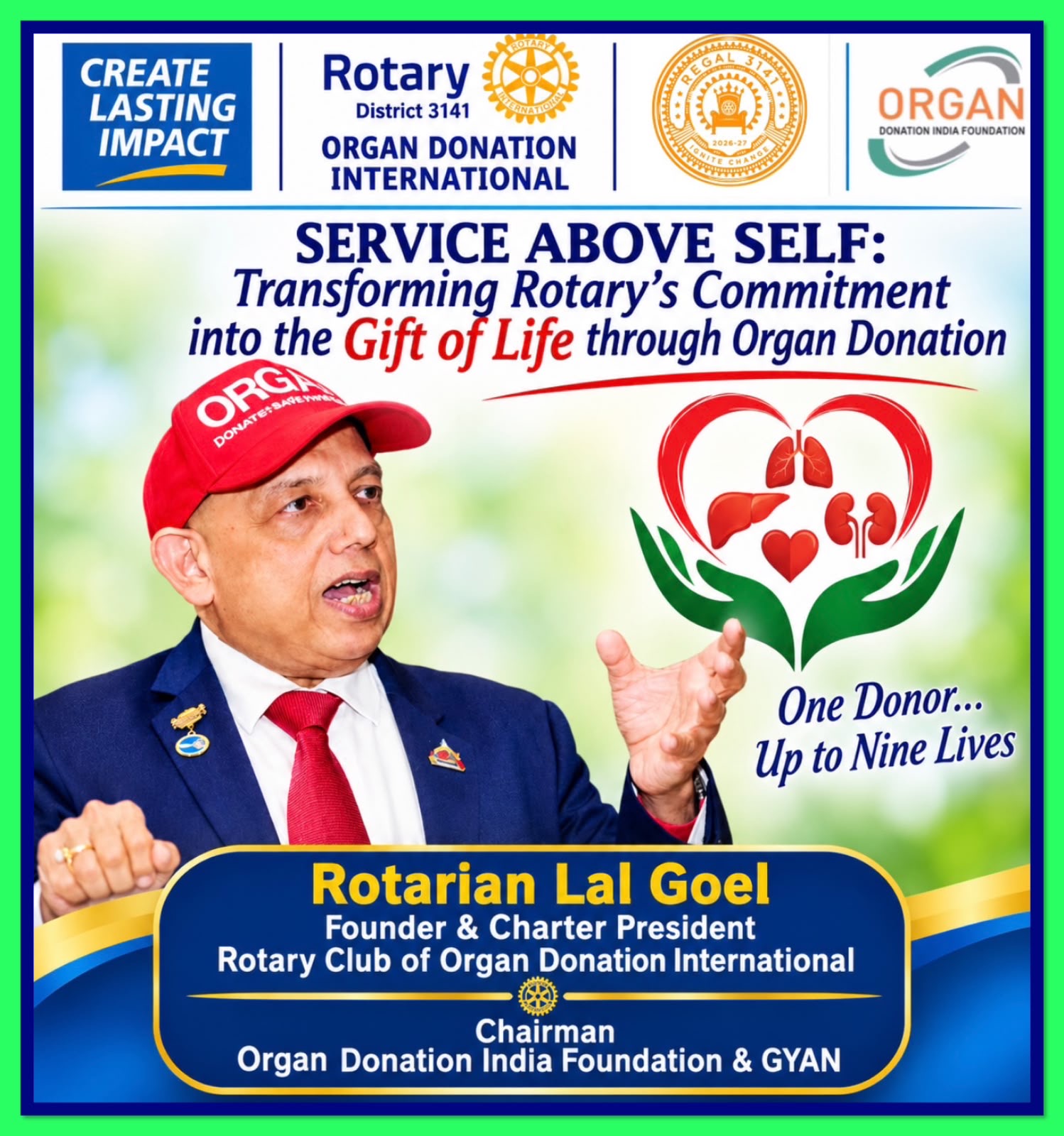
Author: Rotarian Lal Goel
Founder & Charter President
Rotary Club of Organ Donation International
Chairman
Organ Donation India Foundation & GYAN
Rotary’s timeless motto is “Service Above Self.” It means serving humanity without expecting personal gain, recognition or reward. But have we truly understood the depth of this philosophy? Are we practising it to its fullest extent?
Does our commitment to selfless service end when we cease to be Rotarians? Does it end when our active life comes to an end? Or can we continue serving humanity even after our death?
In my opinion, the true meaning of Service Above Self should extend beyond our lifetime. We should not only serve society while we are alive but also leave behind a legacy of service after we are gone. Organ and tissue donation gives us precisely this extraordinary opportunity.
Organ and tissue donation is one of the finest expressions of Service Above Self because it allows us to continue serving humanity even after death.
WHAT DO OUR RELIGIONS TEACH US ABOUT LIFE AFTER DEATH?
Religions across the world have different beliefs about life after death, but they share profound teachings about compassion, kindness, generosity and service to humanity. Let us examine some of these beliefs.
Hinduism
Hinduism teaches about the cycle of birth, death and rebirth, governed by Karma. Good deeds (Punya) and wrong deeds (Paap) influence one’s spiritual journey. The ultimate goal is Moksha—liberation from the cycle of birth and death.
In the Bhagavad Gita, Lord Krishna teaches us to perform our Dharma and duties without attachment to the fruits of our actions.
If we truly follow this teaching, should we not serve humanity without worrying about personal rewards, whether Moksha or Swarg (heaven)? Should we not consider organ and tissue donation an opportunity to fulfil our duty towards humanity, without expecting anything in return?
Islamp
Islam believes in life after death, resurrection and accountability before Allah. A person’s deeds during their lifetime are considered on the Day of Judgement, and Jannat (Paradise) and Jahannam (Hell) are central concepts in Islamic belief.
The Quran places great importance on saving human life, compassion and helping those in need. Organ donation, where accepted in accordance with religious interpretation, can be a powerful expression of this humanitarian spirit.
Christianity
Christianity teaches that everyone will ultimately stand before God. The Day of Judgement is when humanity will come into God’s presence and be accountable for its thoughts, words and actions.
Jesus Christ particularly emphasised compassion towards the poor, the vulnerable and those in need. His teachings remind us that serving others is an essential expression of faith.
Jainism
Jainism believes in the cycle of birth, death and rebirth, governed by the law of Karma. The ultimate spiritual goal is Moksha—liberation of the soul from this cycle and the attainment of its pure state.
Ahimsa (non-violence), compassion towards all living beings and Aparigraha (non-possessiveness) are fundamental Jain principles. Organ and tissue donation, when undertaken voluntarily and in accordance with individual beliefs, can be seen as an expression of compassion, generosity and detachment from material possessions.
Sikhism
Sikhism believes in reincarnation and the cycle of birth and death. The ultimate spiritual goal is Mukti (liberation), achieved through God’s grace, devotion and righteous living, ultimately attaining union with Waheguru.
Seva (selfless service), Daya (compassion) and Sarbat da Bhala (the welfare of all humanity) are fundamental Sikh values. Helping others without discrimination or expectation of reward is central to Sikh philosophy.
Organ donation beautifully reflects this spirit: giving an unknown person another chance at life, irrespective of religion, caste, community or background.
*Buddhism*
Buddhism believes in rebirth and the cycle of Samsara, influenced by Karma. The ultimate spiritual goal is Nirvana—freedom from suffering, attachment and the cycle of rebirth.
Karuna (compassion), Metta (loving-kindness) and Dana (generosity) are central Buddhist teachings. Helping others overcome suffering is an important expression of Buddhist philosophy.
Organ and tissue donation can be viewed as an opportunity to practise compassion and generosity by giving others the possibility of life and a better quality of life.
*ONE HUMANITY, ONE UNIVERSAL MESSAGE*
Different religions may have different interpretations of what happens after death and how one attains liberation. But their teachings offer profound lessons in compassion, kindness, generosity and service to others.
We may worship differently, pray differently and have different beliefs about life after death, but the suffering of a patient waiting for an organ is the same, irrespective of religion.
Organ donation is not about which religion we follow. It is about how much we care for another human being.
It is important to recognise that religious interpretations of organ donation may differ, and individuals should be encouraged to make informed decisions in accordance with their beliefs. However, the humanitarian values of these faiths provide powerful inspiration for giving.
SERVICE SHOULD NOT END WITH OUR LAST BREATH
As Rotarians, we undertake numerous service projects during our lifetime. We help the underprivileged, support education, improve healthcare and work towards a better society. These are all commendable expressions of Rotary’s motto.
But imagine if every Rotarian also pledged to donate organs and tissues, discussed the decision with family members and encouraged others to do the same.
A deceased organ donor can potentially save up to nine lives, while tissue donation can improve the quality of life of many more people. A single decision can bring hope to several families desperately waiting for a second chance at life.
We may not be able to take our possessions, wealth or achievements with us when we die. But we can certainly leave behind something far more precious—the gift of life.
This is not about earning Moksha, reaching Jannat or securing a place in Swarg. It is about doing something good because another human being needs our help. It is about giving without expecting anything in return.
*A CALL TO EVERY ROTARIAN*
The Rotary Club of Organ Donation International (RCODI) was established with the conviction that organ donation deserves to become an integral part of Rotary’s humanitarian service.
Our responsibility is not limited to creating awareness. We must inspire action. Every Rotarian should understand organ donation, make an informed pledge, discuss the decision with family members and become an ambassador for this noble cause.
Rotary clubs should actively collaborate with hospitals, medical professionals, government agencies and social organisations to strengthen awareness, organ retrieval infrastructure and transplantation facilities.
India has a tremendous gap between the number of patients needing organs and the availability of donated organs. We cannot remain satisfied with occasional awareness programmes when thousands of lives are at stake. We need sustained, proactive and collective action.
Let us ask ourselves one simple question:
If we believe in Service Above Self, why should our service end with our death?
We are not God, but God has given us the power to save up to nine lives and improve many more through organ and tissue donation.
Let us make our lives meaningful through service and our departure meaningful through donation.
Let us practise what we preach.
SERVICE ABOVE SELF IS NOT JUST ABOUT HOW WE LIVE. IT IS ALSO ABOUT HOW WE CAN CONTINUE TO GIVE AFTER WE DIE.
One Donor. Up to Nine Lives. Infinite Gratitude.