
How Rotary can lead another life-saving movement in India
by Suman Gupta
24 October, World Polio Day | Celebrating Rotary’s achievement and renewing our commitment to humanity
Author: *Rotarian Lal Goel
Founder & Charter President*
Rotary Club of Organ Donation International*
Chairman
Organ Donation India Foundation & GYAN
Every year, 24 October is World Polio Day, a reminder of the extraordinary progress made against poliomyelitis and the work still needed to eradicate polio globally. Wild poliovirus remains endemic in Pakistan and Afghanistan, so surveillance and immunisation must continue everywhere.
For Rotary, the day has special significance. It celebrates one of the most remarkable humanitarian missions ever undertaken by a voluntary service organisation. It is also a moment to ask how the spirit of Service Above Self can be extended to another urgent public-health challenge: organ donation.
Can the organisation that helped bring the world to the brink of polio eradication now mobilise its network to save thousands of lives through organ donation? The answer is yes, provided we match our commitment with a clear vision, coordinated action and sustained public engagement.
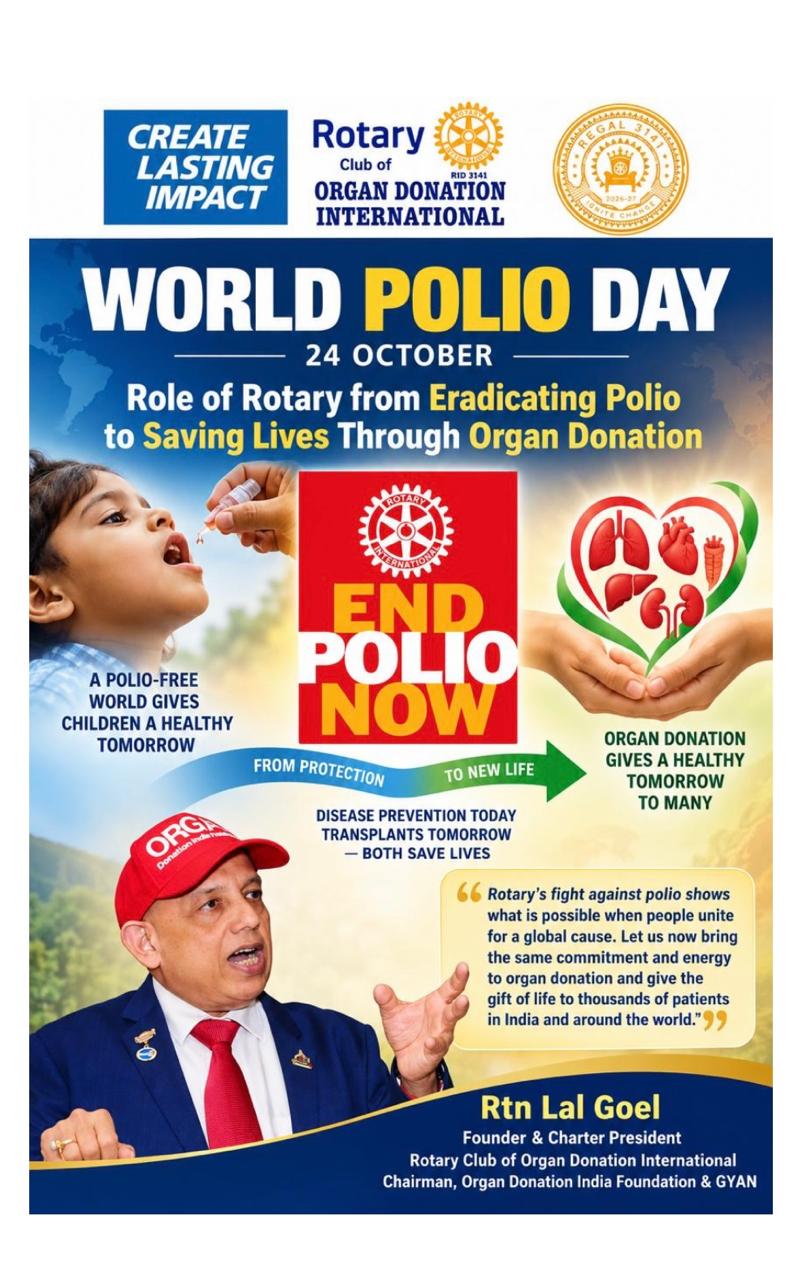
Rotary and the Fight Against Polio
In 1979, Rotary began an immunisation initiative in the Philippines to vaccinate roughly six million children against polio. Its success inspired Rotary to go global. In 1985 it launched PolioPlus, and in 1988 it became a founding partner of the Global Polio Eradication Initiative (GPEI), alongside the World Health Organisation and other international partners.
The results have been extraordinary. Since the global effort began, polio cases have fallen by more than 99.9%. Rotary reports contributions of over US$2.9 billion, along with countless volunteer hours and sustained advocacy with governments and communities.
Rotary’s role went well beyond funding. Rotarians raised awareness, mobilised volunteers, supported immunisation drives, built community trust and urged governments to stay the course. India’s certification as polio-free in 2014 showed what determined public-health action and community participation can achieve.
The polio campaign shows that a difficult public-health challenge can be overcome when political will, professional expertise, financial resources, and people’s participation work together.
Organ Donation: India’s Next Challenge
Organ transplantation has transformed modern medicine. A donated kidney can free a patient from lifelong dialysis; a donated liver can save someone with end-stage liver disease; donated hearts and lungs can offer a second chance to those who have exhausted other options. Tissue and eye donation can restore sight and improve many lives.
India has made progress. According to the Government of India, 20,019 organ transplants were performed in 2025. Yet only around 18% of these transplants used organs from deceased donors, which shows how much room there is to strengthen deceased organ donation.
India needs more than occasional awareness campaigns. It needs a sustained, nationwide movement that encourages informed pledges, prepares families to discuss their wishes, strengthens hospital systems and makes deceased organ donation more accessible and effective. This is where Rotary can make a difference.
Why Rotary Is Uniquely Positioned
Rotary has more than 1.2 million members worldwide, including doctors, business leaders, educators, entrepreneurs, social workers and community leaders. Its particular strengths are:
1. A trusted community network. Rotary Clubs operate in cities, towns and villages across India and can reach people who never attend a hospital-based programme.
2. Experience in mass mobilisation. The polio campaign showed Rotary’s ability to repeat a simple, important message and rally people around a shared goal.
3. Partnerships with professionals. Rotary can connect transplant surgeons, physicians, intensivists, nurses, transplant coordinators, hospitals and government agencies with community organisations.
4. International collaboration. Rotary can bring in successful practices from countries with established deceased donation systems and adapt them to India’s legal, cultural and healthcare context.
5. Long-term commitment. Organ donation needs year-round education, local projects, partnerships and measurable goals, not a single annual observance.
A Five-Point Action Plan
Make every Rotary Club an organ donation awareness centre
Clubs should hold regular programmes in schools, colleges, workplaces, hospitals and community gatherings. The message is simple: learn the facts, make an informed decision, register your pledge through the official national system and discuss your wishes with your family.
Rotarians must be equipped with accurate information on brain-stem death, organ retrieval, religious concerns, donor eligibility and legal safeguards. Awareness must lead to informed action, not merely the distribution of pamphlets or the collection of signatures.
Build a network of Organ Donation Ambassadors
Rotary can develop trained ambassadors from among its members and the wider community: doctors, nurses, students, teachers, social workers, living donors, transplant recipients and donor families who wish to share their experiences. Training should cover the science of donation, the difference between brain-stem death and coma, legal requirements, ethical communication, family counselling and the pledge process. The goal is trained advocates in every district, reaching progressively into rural and underserved communities.
Strengthen hospitals and the deceased donation system
Awareness alone cannot save lives if hospitals lack the capacity to identify potential donors and coordinate donation. Rotary should work with the National Organ and Tissue Transplant Organisation (NOTTO), Regional and State Organ and Tissue Transplant Organisations (ROTTOs and SOTTOs), hospitals and state health departments to find practical gaps and support solutions.
Rotary can also explore specialised infrastructure such as Mobile Organ Retrieval Centres, in partnership with authorised institutions and competent medical teams. Governments remain essential partners, and these efforts must complement, not replace, the responsibilities of governments and healthcare institutions.
Take organ donation education to young Indians
Young people become powerful advocates when they receive accurate information early. Rotary should promote age-appropriate education in schools and colleges, with programmes through Interact and Rotaract Clubs. Students can organise debates, poster competitions, street plays, short films and social-media campaigns, and take the conversation home to their families. The aim is a generation that sees organ donation as an informed, ethical and compassionate choice.
Set measurable national goals
Rather than leaving efforts isolated among individual clubs, Rotary should consider a coordinated campaign with clear targets, set with NOTTO and state authorities according to local needs and infrastructure. Possible indicators include:
Clubs running sustained awareness programmes.
People reached through educational initiatives.
Trained Organ Donation Ambassadors.
People supported in registering pledges through official channels.
Hospitals and professional institutions engaged.
Districts with active awareness partnerships.
Documented improvements in local donation and referral systems.
Pledges are an important first step, but they are not the same as donations. Progress must also be judged by lawful donor identification, family authorisation, hospital readiness and completed transplants.
Principles That Must Guide the Movement
Government campaigns cannot substitute for continuous community engagement, just as public enthusiasm cannot substitute for adequate hospital infrastructure. Rotary can help bridge the gap by bringing citizens, healthcare professionals, institutions and public authorities together.
The ambition should be to make organ donation a subject discussed openly in every household, not only when a family faces a medical emergency. A pledge expresses a person’s wishes; actual donation after death depends on medical suitability, applicable law, family discussion and the circumstances at the time. Throughout, we must protect the dignity of donors and their families, uphold voluntary donation, and oppose commercial exploitation and organ trafficking.
From PolioPlus to a Life-Giving Movement
The fight against polio did not succeed through awareness alone. It took funding, vaccines, trained personnel, public-health systems, government partnerships and volunteers who reached communities again and again. Organ donation needs the same determination, adapted to a different medical and ethical context.
Imagine Rotary Clubs across India holding regular education programmes, every Rotarian able to explain deceased organ donation with confidence, schools and colleges becoming centres of awareness, and hospitals backed by strong community support for lawful and ethical donation. Such a movement would not remove every barrier overnight, but it could build the public understanding, institutional partnerships and civic commitment needed to save many more lives.
The opportunity is not to replace Rotary’s fight against polio, but to extend its legacy of service to another cause where collective action can make a profound difference.
A Call to Every Rotarian
On 24 October, as Rotarians celebrate the progress achieved against polio, let us ask: what is the next great humanitarian challenge to which we can bring our collective strength? Organ donation deserves that commitment.
Let every Rotary District consider a structured organ donation action plan.
Let every Rotary Club appoint an Organ Donation Chair or Ambassador.
Let every Rotarian help at least one family understand the facts and make an informed decision.
Let us work with medical institutions and government agencies to strengthen the systems that turn a donor’s decision into a real opportunity for transplantation.
Let our efforts continue throughout the year, not just on World Polio Day or Indian Organ Donation Day.
The task is challenging, but the potential to save lives is enormous.
LET US MOVE FROM FIGHTING DISEASE TO GIVING LIFE.
LET EVERY ROTARIAN BECOME AN ORGAN DONATION AMBASSADOR.
LET ROTARY HELP INDIA BECOME A NATION OF ORGAN DONORS.
Service Above Self. Giving Life Beyond Life.
Rotary Club of Organ Donation International (RCODI) is promoting awareness. Inspiring action. Saving lives.