
Author: Rotarian Lal Goel
Founder & Charter President
Rotary Club of Organ Donation International
Chairman
Organ Donation India Foundation & GYAN
India has made remarkable progress in medical education. The number of medical colleges has increased from 387 in 2014 to approximately 846 in 2026. Yet, when it comes to deceased organ donation, we are failing to utilise the enormous potential of our expanding healthcare infrastructure.
According to NOTTO’s Annual Report 2025–26, India’s national organ transplantation network comprises 764 transplant centres and 149 Non-Transplant Organ Retrieval Centres (NTORCs). While this represents encouraging progress, the network remains inadequate for a country of India’s geographical size and population.
WHY SHOULD EVERY MEDICAL COLLEGE NOT BECOME AN ORGAN RETRIEVAL CENTRE?
Medical colleges are strategically located across states, cities and underserved regions. Many affiliated teaching hospitals already have intensive care units, ventilators, operation theatres, emergency departments and qualified medical professionals. They are ideally positioned to identify potential brain-stem-dead donors and facilitate timely organ retrieval.
Unfortunately, infrastructure alone does not translate into organ donation. Administrative delays, lack of trained personnel, inadequate coordination, insufficient awareness and reluctance to take responsibility often prevent hospitals from participating actively in the deceased-donation programme.
Are we facing red-tapism? Is it a shortage of appropriately trained doctors? Or is it simply a lack of institutional commitment? These questions demand urgent answers.
BRAIN-STEM DEATH CERTIFICATION IS NOT AN INSURMOUNTABLE OBSTACLE
Under the Transplantation of Human Organs Act (THOA), 1994 & Transplantation of Human Organs and Tissues Act (THOTA), 2011 and the 2014 Rules, brain-stem death is certified by a four-member Board of Medical Experts comprising:
1. The registered medical practitioner in charge of the hospital.
2. An independent specialist nominated from the panel approved by the Appropriate Authority.
3. A neurologist or neurosurgeon nominated from the approved panel.
4. The registered medical practitioner treating the patient.
Importantly, when a neurologist or neurosurgeon is unavailable, the Rules provide for an alternative arrangement involving an appropriately nominated surgeon or physician and an anaesthetist or intensivist, subject to prescribed requirements.
This provision removes a major practical hurdle for medical colleges in smaller cities and rural areas.
Brain-stem death certification must follow all statutory safeguards and remain independent of organ retrieval and transplantation requirements. The process must never be influenced by the interests of a potential recipient.
MY PROPOSAL: MAKE ORGAN RETRIEVAL CENTRES MANDATORY IN ALL MEDICAL COLLEGES
The Government of India, in consultation with the National Medical Commission (NMC), NOTTO and State Governments, should introduce a time-bound national policy requiring every medical college with an affiliated teaching hospital to establish a registered organ retrieval centre, subject to prescribed infrastructure and regulatory standards.
Every such centre should:
* Establish a designated organ retrieval facility with the necessary ICU, operation theatre and supporting infrastructure.
* Have an approved and trained brain-stem death certification panel.
* Appoint a dedicated transplant coordinator and organ donation team.
* Establish 24-hour coordination with SOTTO, ROTTO and NOTTO.
* Develop protocols for potential donor identification, family counselling, organ preservation and transportation.
* Conduct regular training programmes for doctors, nurses and other healthcare professionals.
* Organise continuous organ donation awareness programmes for patients, families, medical students and the general public.
Medical colleges with adequate infrastructure, specialist teams and sufficient clinical volumes should additionally be developed as full-fledged organ transplantation centres.
LOOK AT THE DISPARITY IN OUR COUNTRY
Consider Uttar Pradesh, with a population of approximately 240 million (24 crore), India’s most populous state.
According to Government of India data provided in a Lok Sabha reply in July 2022, Uttar Pradesh had 17 registered organ transplant centres and two organ retrieval centres, making a total of 19.
As per an unconfirmed recent report, the number of organ transplant and retrieval centres in the state has almost doubled since then. However, even this reported increase needs to be viewed against the state’s enormous population and geographical spread.
Now compare this with New Jersey in the United States, which has a population of approximately 9.5 million (95 lakh).
New Jersey is served by six organ transplant centres and more than 50 hospital partnerships through the NJ Sharing Network. These partnerships demonstrate how a relatively small state can develop an organised hospital-wide organ procurement network.
The comparison is not between identical categories of facilities. However, it clearly demonstrates the importance of an extensive, coordinated network for identifying potential donors and facilitating organ retrieval.
If New Jersey can establish such an extensive network of hospital partnerships, why can’t India develop a similar system across its hundreds of medical colleges and teaching hospitals?
AN IMMEDIATE SOLUTION: INTRODUCE MOBILE ORGAN RETRIEVAL CENTRES
While establishing organ retrieval centres in every medical college is an essential national policy, we must recognise that implementing such a policy will take time.
Meanwhile, thousands of patients are waiting for organs, and precious lives are being lost every day. We cannot afford to wait for years for the necessary infrastructure to be developed.
It is therefore high time that the Government of India, in consultation with NOTTO and State Governments, gives immediate approval for introducing Mobile Organ Retrieval Centres (MORCs) to serve unserved and underserved regions of the country.
These mobile units could be equipped with suitable operating theatre facilities, medical equipment, organ preservation systems and trained technical personnel. They could operate in coordination with identified hospitals, medical colleges, SOTTOs, ROTTOs, ZTCCs, Jeevansarthkate etc enabling timely organ retrieval from eligible deceased donors in areas where adequate retrieval infrastructure is unavailable.
ROTARY AND OTHER NGOs CAN PLAY A MAJOR ROLE.
Rotary Clubs, Rotary International, organ donation NGOs, charitable foundations and CSR partners can help establish and support these Mobile Organ Retrieval Centres.
Through public-private partnerships and philanthropic contributions, these organisations can provide the necessary infrastructure and operational support without placing an additional financial burden on the Government treasury.
The Government’s role would be to facilitate regulatory approvals, establish standard operating procedures, ensure quality and safety standards, and coordinate the network. Voluntary organisations and philanthropic institutions could contribute towards infrastructure, equipment and operational support.
MORCs would function as mobile surgical retrieval units, not independent transplant hospitals. They must work with appropriately authorised hospitals, trained retrieval teams, approved brain-stem death certification processes and established organ transportation networks.
This is a unique opportunity for the Government and civil society to work together. We should not allow the absence of a permanent retrieval centre to become a reason for losing a potential organ donor.
Long-term policy reform and immediate practical action must go hand in hand. Every day matters. Every donor matters. Every life matters.
THE ENORMOUS OPPORTUNITY BEFORE INDIA
India performed a record 20,138 organ transplants in 2025, including 3,526 deceased-donor organ transplants. Although this represents substantial progress, deceased-donor transplantation still accounts for only a small proportion of the country’s total transplants.
Every potential deceased donor lost because of delayed identification, inadequate infrastructure, lack of coordination or administrative inaction represents a missed opportunity to save lives.
We must stop treating organ donation as an occasional activity of a few specialised hospitals. It must become an integral institutional responsibility of our entire healthcare system.
The Government has taken several initiatives, but voluntary participation and awareness campaigns alone will not bridge the gap. We need mandatory institutional preparedness, accountability, trained manpower, dedicated budgets and continuous monitoring.
Imagine the transformation if all 846 medical colleges actively participated in the organ donation movement, supported by Mobile Organ Retrieval Centres in underserved regions. Thousands of additional potential donors could be identified over time, and many more lives could be saved.
A medical college must not merely teach students how to save lives. It must also be equipped and committed to saving lives through organ donation.
Let us make every medical college a potential gateway to life for someone waiting for an organ. Let us also empower Rotary and other NGOs to become active partners in building the infrastructure required to save lives.
OUR TWO NATIONAL DEMANDS:
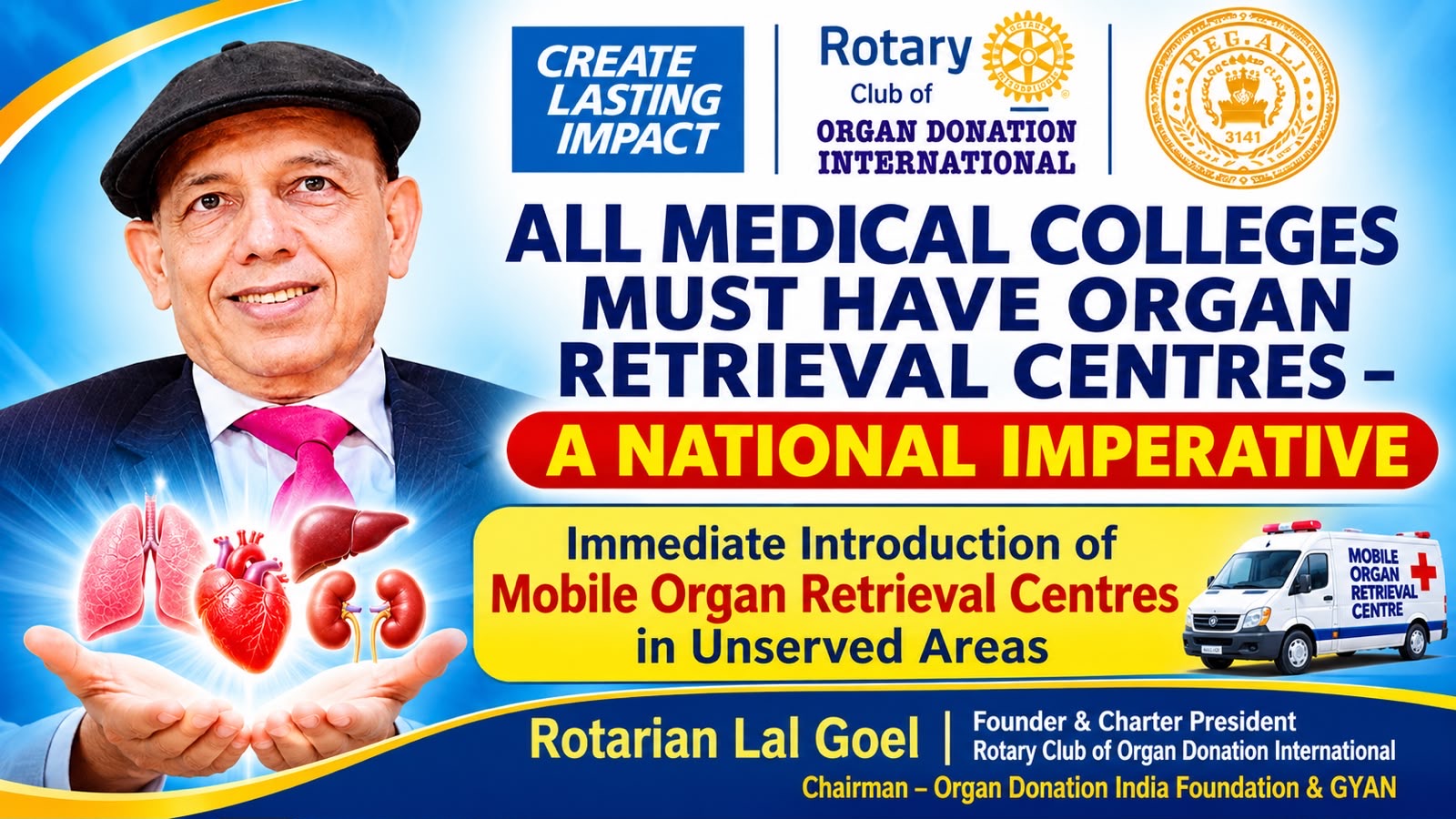
1. MAKE ORGAN RETRIEVAL CENTRES MANDATORY IN ALL MEDICAL COLLEGES.
2. INTRODUCE MOBILE ORGAN RETRIEVAL CENTRES IMMEDIATELY IN UNSERVED AND UNDERSERVED AREAS.
ONE DONOR. NINE LIVES. INFINITE GRATITUDE.
SOURCES AND REFERENCES
1. _National Organ and Tissue Transplant Organisation (NOTTO), Annual Report 2025–26 – national transplant, retrieval and tissue banking network._
2. _Ministry of Health and Family Welfare, Government of India – parliamentary information on the number of medical colleges._
3. _Ministry of Health and Family Welfare – Lok Sabha reply, July 2022, providing Uttar Pradesh’s organ transplant and retrieval centre figures._
4. _Transplantation of Human Organs Act, 1994, and Transplantation of Human Organs and Tissues Rules, 2014 – brain-stem death certification provisions._
5. _NJ Sharing Network, USA – official information on six transplant centres and more than 50 hospital partnerships._
6. _NOTTO transplant registry – 2025 organ transplantation statistics._